LIFTR.
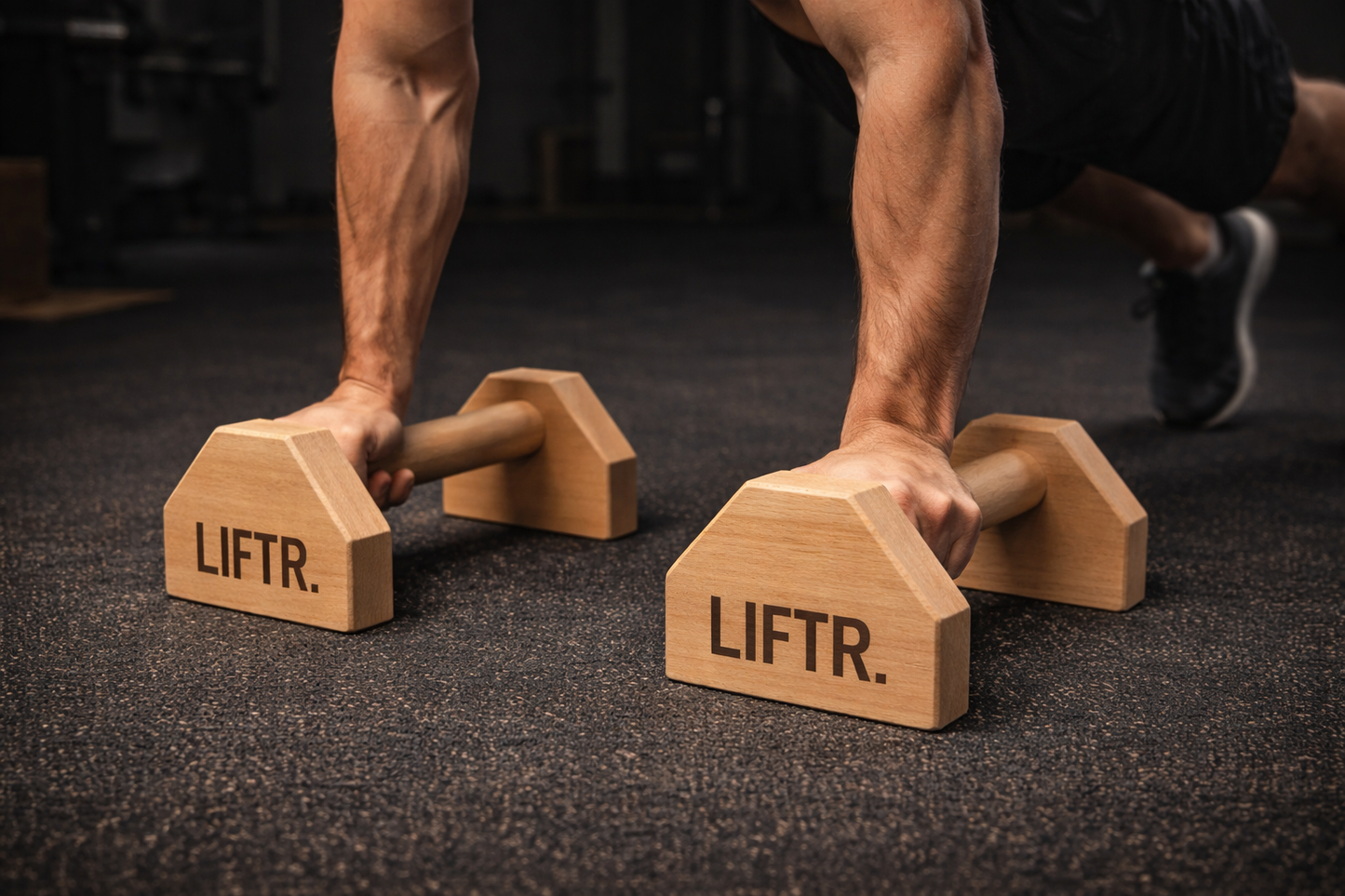
LIFTR Wooden Parallettes | 25cm | Solid Wood Handstand Bars for Calisthenics, Push-Ups & Gymnastics Training
LIFTR Wooden Parallettes | 25cm | Solid Wood Handstand Bars for Calisthenics, Push-Ups & Gymnastics Training
Couldn't load pickup availability
LIFTR Wooden Parallettes are 25cm solid wood handstand and calisthenics bars designed for push-ups, L-sits, handstands, planche progressions, and gymnastics training. The wide hex-shaped base provides a stable, no-rock platform on any surface, while the ergonomic round handle offers a comfortable, secure grip across long training sessions. Suitable for beginners working on wrist-friendly push-ups through to advanced athletes training hand-balancing and planche skills.
Key Features
Key Features
Solid wood construction — stable, durable, and naturally grippy
Made from solid wood with a smooth sanded finish, the LIFTR Parallettes provide a firm, secure grip surface without requiring chalk or grip tape. The natural wood finish is sweat-resistant and comfortable on the hands during extended holds and high-rep push-up sets. Solid wood construction means no flex or movement in the handle under bodyweight load — delivering a stable, predictable platform for every movement.
Wide hex-shaped base — no rocking on any surface
The hex base design provides a wide contact area with the floor, preventing rocking or tipping during dynamic movements, static holds, and transitions. Stable on gym floors, wooden floors, outdoor surfaces, and gym mats. The hex geometry keeps each parallette locked in position throughout handstand training, planche progressions, and push-up sets — removing equipment instability as a variable from your training.
Ergonomic round handle — comfortable grip for long sessions
The round handle geometry distributes grip pressure evenly across the palm, reducing localised wrist strain compared to flat or angular handle designs. Particularly beneficial for extended L-sit holds, handstand training, and planche progressions where wrist comfort is a limiting factor for training volume. A key reason wooden parallettes are preferred over metal or plastic alternatives for long-session calisthenics work.
25cm height — elevated platform for full range of motion
At 25cm height, the LIFTR Parallettes provide enough elevation for full range-of-motion push-ups with chest below handle level, L-sit clearance for most athletes, and a stable base for handstand kick-ups and holds. The 25cm height is the standard for short parallettes and suits the majority of calisthenics and gymnastics training applications without the footprint or storage requirements of full-length parallettes.
Full range of calisthenics and gymnastics applications
One set of parallettes covers push-ups and elevated push-up variations, L-sits and tuck L-sits, handstand training and kick-up practice, planche progressions from tuck through to advanced straddle positions, V-sits, dips, and pike push-ups. The parallette is the single most versatile piece of equipment for wrist-position calisthenics and hand-balancing training — a set covers every stage of a long-term gymnastics or calisthenics skill programme.
Lightweight and portable — train anywhere
The pair is lightweight enough to carry in a gym bag or training pack for outdoor calisthenics sessions, park training, travel, and studio use. No assembly, no installation, no maintenance — place them down and train. Compact enough to store in a corner, under a desk, or in a bag between sessions.
Specifications
Specifications
- Height: 25cm
- Material: Solid wood
- Handle shape: Round ergonomic grip
- Base design: Wide hex-shaped base
- Finish: Smooth sanded natural finish
- Quantity: Pair (2 parallettes)
- Colour: Natural wood
Best suited to: Push-ups and elevated push-up variations · L-sits and tuck L-sits · Handstand training and kick-up practice · Planche progressions · V-sits · Pike push-ups · Dips · Gymnastics conditioning · Home gym calisthenics training · Outdoor training
How to Use
How to Use
Setting up
Place the parallettes on a flat, stable surface with the hex base sitting flush to the floor. Position them shoulder-width apart as a starting point — adjust inward or outward depending on the exercise and your shoulder width. No assembly required. Ensure the surface is clean and dry before use to maintain the natural grip of the wood base.
Push-ups and elevated push-up variations (beginner to intermediate)
Grip the handles with palms facing down and wrists in a neutral position. Perform push-ups as normal — the elevated handle height allows a greater range of motion than floor push-ups, with the chest able to travel below handle level at the bottom of each rep. The round handle also keeps the wrists in a more neutral position than flat-palm floor push-ups, reducing wrist extension stress during high-rep sets.
L-sit holds (intermediate)
Grip both handles and press your bodyweight up so your arms are fully extended. Lift both legs out straight in front until your body forms an L-shape — hips at handle height, legs parallel to the floor. Hold the position for timed sets. If a full L-sit is not yet achievable, begin with a tuck L-sit — knees pulled to chest — and extend one leg at a time as hip flexor strength develops. The 25cm height provides enough clearance for most athletes to achieve full L-sit leg extension without contacting the floor.
Handstand training (intermediate to advanced)
Position the parallettes on a flat surface with enough clear space behind for a kick-up. Grip the handles, kick up into a handstand, and balance with arms locked out and body vertical. The stable hex base keeps the parallettes fixed during kick-up transitions, and the round handle allows slight wrist adjustment for balance corrections without losing grip. Beginners can practise wall-assisted handstands using the parallettes against a wall before progressing to freestanding holds.
Planche progressions (advanced)
Grip the handles with arms straight and lean forward, shifting bodyweight over the hands. Begin with tuck planche holds — knees tucked to chest — and progress through advanced tuck, straddle, and full planche positions over time. The stable hex base and solid wood construction are critical for planche training, where significant horizontal force is applied to the equipment during forward lean positions.
Dips (intermediate)
Position the parallettes far enough apart to sit between them with your hands gripping each handle. Press up to a support position with arms locked out. Lower your body under control until your upper arms are at or below parallel, then press back up to full extension. Parallette dips have a greater range of motion than bench dips and more closely replicate bar dips for tricep and chest development.
FAQs
FAQs
What are parallettes used for?
Parallettes are short wooden or metal bars used to elevate the hands above the floor for calisthenics and gymnastics training. They are primarily used for push-ups with extended range of motion, L-sit holds, handstand training, planche progressions, V-sits, pike push-ups, and dips. The elevated handle position allows movements that are not possible from the floor, and the round handle keeps the wrists in a more neutral position than flat-palm floor training — making parallettes a key tool for wrist-friendly calisthenics and hand-balancing skill development.
What height parallettes should I buy?
25cm parallettes — the height of the LIFTR range — are the standard for most calisthenics and gymnastics training applications. They provide enough elevation for full range-of-motion push-ups, L-sit clearance for most athletes, and a stable base for handstand training, without the bulk or storage requirements of taller parallettes. Taller parallettes (40cm+) are primarily used for advanced dip training and specific planche variations — for most athletes, 25cm covers every training requirement.
Are wooden parallettes better than metal parallettes?
Wooden parallettes are generally preferred for calisthenics and gymnastics training for two reasons: grip and comfort. The natural wood surface provides a secure grip without chalk across most training movements, and the round wood handle is more comfortable during extended holds — L-sits, handstands, and planche progressions — than metal alternatives. Metal parallettes are more common in commercial gym settings for durability reasons, but for home gym and personal training use, wood is the preferred material among calisthenics athletes.
Are parallettes suitable for beginners?
Yes. Parallettes are suitable for any athlete who can perform bodyweight push-ups and is looking to progress their calisthenics or gymnastics training. Beginners typically start with elevated push-ups and tuck L-sit holds — both accessible movements that build the wrist, shoulder, and core strength needed for more advanced parallette skills. The same set of parallettes supports progression through L-sits, handstands, and planche training over a long-term training programme.
What is the difference between parallettes and push-up handles?
Push-up handles are designed primarily for elevated push-ups and are typically low-profile, lightweight, and not intended for static holds or handstand training. Parallettes are a more substantial training tool — taller, more stable, and built for a wider range of movements including L-sits, handstands, planche progressions, and dips. If your training goal goes beyond push-ups, parallettes are the more versatile and appropriate choice.
Can parallettes be used on any floor surface?
Yes. The LIFTR Parallettes' hex base design provides a wide, stable contact area suitable for use on gym floors, wooden floors, tiles, and outdoor surfaces. For use on smooth or polished floors, placing the parallettes on a gym mat adds additional grip and prevents any surface movement during dynamic movements and handstand training.
How do I progress from push-ups to handstands using parallettes?
A structured progression on parallettes typically follows this path: elevated push-ups → tuck L-sit holds → full L-sit → pike push-ups → wall-assisted handstand holds on parallettes → freestanding handstand kick-up practice → freestanding handstand holds. Each stage builds the wrist strength, shoulder stability, and body awareness required for the next. The parallettes support every stage of this progression on the same equipment without modification.
Delivery & Returns
Delivery & Returns
Delivery
- Free UK delivery on orders over £50
- Next day delivery on orders placed before 2pm (Mon–Fri)
- International delivery calculated at checkout (varies by location and order size)
- All orders tracked — tracking info provided once dispatched
Returns
- 30-day returns on unused items
- Wrong or faulty item? We'll cover the return postage
- All other returns are at the customer's cost
- To start a return, email sales@lift-r.co.uk with your order number
Share